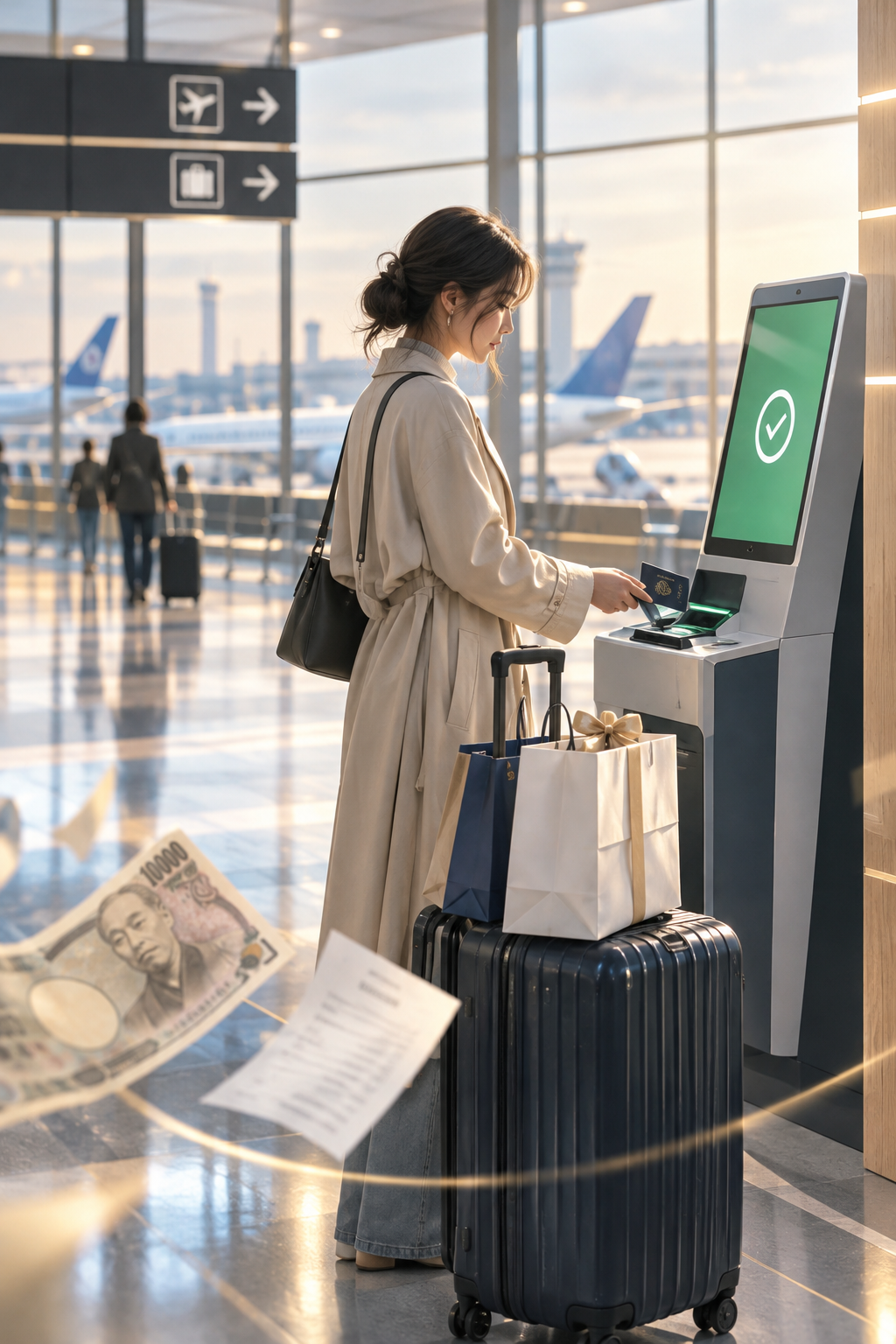
Japan’s Tax-Free Shopping Just Changed: What Every Tourist Must Do Now
Open one box of matcha KitKats in your Tokyo hotel, and you can lose the tax refund on everything else printed on that receipt. Since November 1, 2026, tax-free shopping in Japan has worked in reverse: you pay the full price, consumption tax included, and only get the tax back after Japan Customs confirms at departure that your goods are leaving the country.
We checked the new system, which the Japan Tourism Agency calls the refund method, against the agency’s own traveler FAQ and the National Tax Agency’s leaflet. We found seven ways to lose all or part of your refund, and six of them are avoidable with a little planning at the register and at the airport.
Our verdict: the paperwork is the small problem. The kiosk check itself takes seconds, according to the Tourism Agency. The real costs are one badly planned receipt and a refund fee nobody has capped.
Watch the full video on YouTube
Old system vs. refund method
The purchase date decides which rules apply. The new rules cover anything bought on or after November 1, 2026, so if your trip crossed that date, keep the two sets of purchases apart.
| Rule | Until October 31, 2026 | From November 1, 2026 |
|---|---|---|
| At the register | Tax taken off | Full price, tax included |
| Minimum spend | ¥5,000 before tax, per store, per day | ¥5,000 before tax, per store, per day |
| Product categories | General goods and consumables, counted separately | No categories |
| Maximum spend | ¥500,000 on consumables | No cap; limited to what you can personally carry out of Japan |
| Sealed packaging | Required for consumables | Abolished |
| Purpose of use | Goods used for daily life | Any purpose |
| Deadline | Take the goods out of Japan when you leave | Customs confirmation within 90 days of purchase |
The 90 days start the day after you buy. The National Tax Agency’s example: buy something on November 1, and your deadline is January 30.
Who qualifies, and what is excluded
- Most tourists: foreign nationals on Temporary Visitor status who have been in Japan for less than six months since entry. Show your passport at the store.
- Cruise passengers: passport, or a copy of it, plus the cruise landing permit.
- Japanese citizens living abroad: in Japan for less than six months since their temporary return, with a passport and a document proving at least two years of residence overseas. They cannot use the online option at the airport.
- Excluded goods: gold and platinum bullion and coins, and products already exempt from consumption tax. Finished jewelry made from them, such as an 18K necklace, still qualifies, according to the Tourism Agency’s FAQ for stores.
Consumption tax is 10% on most goods and 8% on food and soft drinks. Since the minimum is counted before tax, you are looking for a tag of about ¥5,500 at the 10% rate, or ¥5,400 at 8%. Japanese price tags often show both figures: 税込 (zeikomi) means tax included, 税抜 (zeinuki) means before tax. Participating stores display a “Japan Tax-Free Shop” sign.
Tax-free is also not the same as duty-free. Airport duty-free shops are a separate system and still take the tax off at the point of sale, as Japan Travel notes.
What you can actually use before you fly
This is where a lot of advice is too broad. “Don’t use anything” is safe but wrong. The Tourism Agency’s FAQ draws the line between consumables and everything else.
| Situation | Official treatment | What to do |
|---|---|---|
| You wear the sneakers or use the camera, and take them home | Still eligible, because the goods leave Japan | Use the kiosk as normal |
| You eat, drink or use up any part of a food, drink, medicine or cosmetic | No customs confirmation and no refund for that receipt | Don’t use the kiosk; report it to a customs officer at the counter |
| One item from a receipt is missing | Nothing on that receipt qualifies | Report it at the customs counter |
| Items from two different purchases, and one is missing | The complete purchase is still refunded; the missing item is not | Report the missing item at the counter |
That last row is the most useful line in the official FAQ. It confirms that each purchase stands alone, including two purchases made one after the other at the same store. So ask the cashier to ring up “use on the trip” items and “take home” items as separate purchases, each with its own receipt. It costs seconds and protects the larger purchase.
One limit we could not resolve: the rules count the ¥5,000 minimum per store, per day, but we found no official statement on how a store must treat a split purchase below that amount. Ask before you split, and don’t assume every store will do it.
How to get the refund, step by step
- At the store: show your passport, pay the full price and follow the shop’s instructions for registering a refund method. Ask who pays the refund and whether there is a fee.
- Before you leave for the airport or seaport: pack everything so you can reach it, including items you plan to check in. Bring the certificate of authenticity or warranty for any item of ¥1 million or more before tax, since customs may ask for it.
- Before baggage check-in: go to a tax-free kiosk or terminal in the international departure lobby and scan your passport. Japan Customs publishes floor maps for each airport and seaport.
- Read the result: green means you are done. Red means you take your goods to the customs inspection area.
- Check in your bags and leave Japan: confirmed goods must be exported without delay. If they aren’t, the tax is collected and penalties apply.
- Collect the refund: it comes from the store or its refund company, by the method set up at purchase.
At Narita, Haneda, Kansai, Chubu, Fukuoka, New Chitose and Naha, you can replace the kiosk with the online procedure in Visit Japan Web. It only works on the dedicated Wi-Fi in the departure lobby, before security.
Situations that change the routine
- Domestic connection: do the procedure at the last airport before you leave Japan, not where your journey starts.
- Round-trip cruise, then a flight home: do it once, at the airport you finally depart from.
- Cruise ending overseas: use the electronic terminal at your final Japanese port, before checking your baggage.
- Knives and anything else that must fly in the hold: the check still comes first. Clear the kiosk, then check the bag.
- Shipping home: mailing goods yourself has not qualified since April 1, 2025. You can still avoid the tax if you arrange transport at the shop and hand the goods over there, or if the shop exports them for you. That falls under a separate export exemption, so the ¥5,000 minimum and the kiosk check don’t apply. Not every shop offers it.
- Receipts: the Tourism Agency says you don’t always have to present them, but customs may ask. Keep them.
Seven ways to lose your refund
| Mistake | What you lose | How to avoid it |
|---|---|---|
| Using up one consumable from a shared receipt | Tax on the whole receipt | Ask for separate purchases |
| Leaving one item behind or giving it away | Tax on the whole receipt | Keep each receipt’s items together until the check |
| Checking your bag first | Tax on everything in it, since checked bags can’t be retrieved for this | Kiosk first, check-in second |
| Missing the 90-day deadline | Tax on that purchase | On long trips, track your oldest receipt |
| Running out of time during an inspection | Tax on the goods not confirmed; no compensation for a missed flight from the airline or customs | Arrive early |
| Mailing goods home yourself | Tax on those goods | Carry them, or use direct shipping from the shop |
| Choosing a refund route with a fee | Part of the refund, 10% at Cash Japan’s standard rate | Ask before you buy |
Who holds your money, and what it costs
The refund doesn’t come from the government. Under the National Tax Agency’s description, the store pays it or entrusts the job to a refund company, and the Consumption Tax Act does not prescribe how. Bank transfer, credit card, app and cash at the port of departure are all possible, and the Tourism Agency tells travelers to ask the shop which ones it offers.
As Unseen Japan reported, citing the Tourism Agency’s guidance for stores, the law doesn’t say who pays the refund company’s fee, and the government hasn’t capped it. The Tourism Agency’s FAQ for stores confirms that the rules don’t say whether the traveler or the store bears the fee, notes that travelers commonly pay it in other countries, and says the government itself takes no fee. The same FAQ allows refunds as coupons or points that only work at certain places.
There is now a real number to work with. Cash Japan, owned by Global Blue, runs cash refund machines and counters at six airports: Narita, Kansai, Chubu, Fukuoka, Kobe and New Chitose. Its standard fee, according to its terms as reported by Executive Traveller and Sing Tao, is 10% of your refund. We ran that rate across some typical purchases:
| Price paid (10% tax included) | Tax in the price | Back to you after a 10% fee | Fee |
|---|---|---|---|
| ¥5,500 | ¥500 | ¥450 | ¥50 |
| ¥11,000 | ¥1,000 | ¥900 | ¥100 |
| ¥55,000 | ¥5,000 | ¥4,500 | ¥500 |
| ¥110,000 | ¥10,000 | ¥9,000 | ¥1,000 |
| ¥550,000 | ¥50,000 | ¥45,000 | ¥5,000 |
Our own calculation, before any rounding by the provider. Cash Japan rounds to ¥50 steps, according to Executive Traveller. Fees at other providers may differ.
Other options exist. At Haneda, Narita and Naha, self-service machines from GLORY and Haneda’s terminal operator pay cash in about a minute, according to Aviation Wire. What that costs depends on the refund company behind your receipt, and we couldn’t find a reliable published rate.
How long a card or bank refund takes is also not set in any official source we found. Japan Travel gives one to two weeks for cards and two to four for bank transfers, and says it varies. Treat those as estimates. The refund company should be named on your receipt, so ask at the register: “How will I get my refund, and is there a fee?”
Don’t stop at the green screen, either. The customs check and the refund are separate steps. The Tourism Agency’s FAQ for stores says a store keeps its tax exemption even if a traveler passed customs but never registered a refund method, and it suggests stores can tell shoppers upfront that refund requests expire after a set number of days. The law sets no such period, so ask whether your store or refund company has one, and finish the registration before you fly.
Why Japan changed the system
Under the old system, the tax vanished at the register and Japan had to trust that the goods left the country. According to Japan’s Board of Audit, nine visitors departing from Narita and Haneda in fiscal 2022 had bought luxury watches and designer bags tax-free and didn’t have them when they left. About ¥340 million in tax went uncollected. One of them, according to reports on that audit, had spent more than ¥1.3 billion.
The Japan Times reported a wider look at the same year: 57 visitors had each bought at least ¥100 million in tax-free goods. Only one was found to be taking them out of Japan. Of the other 56, 55 left without paying the tax they owed, about ¥1.85 billion. The government’s stated concern is goods being resold inside Japan, tax-free.
The refund method moves that risk off the state: the tax is paid first, and it only comes back once the goods have provably left. It also explains an odd new rule. For any item of ¥1 million or more before tax, stores must record details that identify it. For a watch, the National Tax Agency’s example is the brand, model number, color and serial number.
Retailers had to fight to keep tax-free shopping at all. According to nippon.com, a Liberal Democratic Party study group floated reviewing or even abolishing it in 2025, and ten retail groups pushed back, warning it would hurt Japan’s competitiveness.
The checklist
- Check for the “Japan Tax-Free Shop” sign, and carry your passport.
- Ask for separate purchases: one for what you’ll use, one for what stays sealed until home.
- Ask how the refund is paid and what it costs, and note the company on the receipt.
- Keep receipts, and keep each receipt’s items together.
- Watch the 90-day clock on your earliest purchase.
- Arrive early, and go to the kiosk before you check your bags.
- If anything was consumed or is missing, go to the customs counter instead of the kiosk.
Still open: what the other refund companies will charge, and how long airport lines get once the winter rush starts. We haven’t used the new kiosks ourselves yet, so if you have, tell us how it went in the comments.
References
- Japan Tourism Agency: Information on the Tax-Free Shopping System (Refund Method)
- Japan Tourism Agency: Traveler FAQ, when purchasing
- Japan Tourism Agency: Traveler FAQ, when departing
- Japan Tourism Agency: Traveler FAQ, regarding refunds
- Japan Tourism Agency: List of eligible tax-free goods purchasers (PDF)
- Japan Tourism Agency: FAQ for tax-free shops, refund method (Japanese)
- National Tax Agency: Tax-Free Shopping System will be shifted to the Refund Method (PDF)
- Japan National Tourism Organization: Japan’s New Tax-Free Shopping System (July 20, 2026)
- Executive Traveller: Japan’s new tax-free shopping rules leave tourists worse off (November 2, 2026)
- Unseen Japan: Japan’s New Tax-Free Rules Will Give Shoppers Less Money Back (August 19, 2026)
- Aviation Wire: Self Tax Refund machines (October 21, 2026)
- Japan Travel: Tax-free Shopping in Japan, 2026 Changes (October 19, 2026)
- Japan Today / Kyodo: Huge tax evasions in 9 cases highlighted
- Jiji Press via nippon.com: Board of Audit findings, fiscal 2022
- The Japan Times: Visitors’ tax exemption (August 13, 2024)
- nippon.com: Japan Shifts to “Pay Now, Refund Later” Tax-Free Tourist Shopping
- Cash Japan press release, PR Times, October 19, 2026; Sing Tao report on Cash Japan’s terms, October 25, 2026
Disclosure
Neon & Concrete was not paid for this article and received nothing from any retailer, refund company or airport mentioned in it. It contains no sponsored or affiliate links. Rules and figures were checked against the sources above as of November 3, 2026. Fees and procedures can change, so confirm with the store before relying on them.